iPIPE robot
Measuring the wear of supply lines in mining to avoid high downtime costs.
Problem
In mining, pipelines made of special steel carry backfill material (gravel, concrete) used to fill underground cavities. Over time, the material wears the pipelines down.
Replacing them takes several weeks and, at the time of our work, cost up to approx. US$ 1 million for a 500 m pipeline alone. During that time no work is possible in the affected tunnels, and downtime costs can reach several tens of millions of US$.
That is why wear has to be monitored, so that work can be planned in good time. Measurements at the start and end of a time window, together with the type, grain size and quantity of the backfill, give the specific wear and thus the service life of the pipes.
Requirements
- Inspection of vertical pipelines and boreholes with a diameter of 4–32 inches
- Lengths of up to 500 m (standard vertical distance between tunnels)
- Three cameras: axial forward view, radial view of the pipe wall, and axial rear view to monitor the cable
- Accuracy: 0.1 mm for the distance value, 0.1° for the rotation, 0.25 mm for the vertical position
- Speed: 50 mm/s at high resolution (800 points around the circumference), 100 mm/s at low resolution (400 points)
Approach
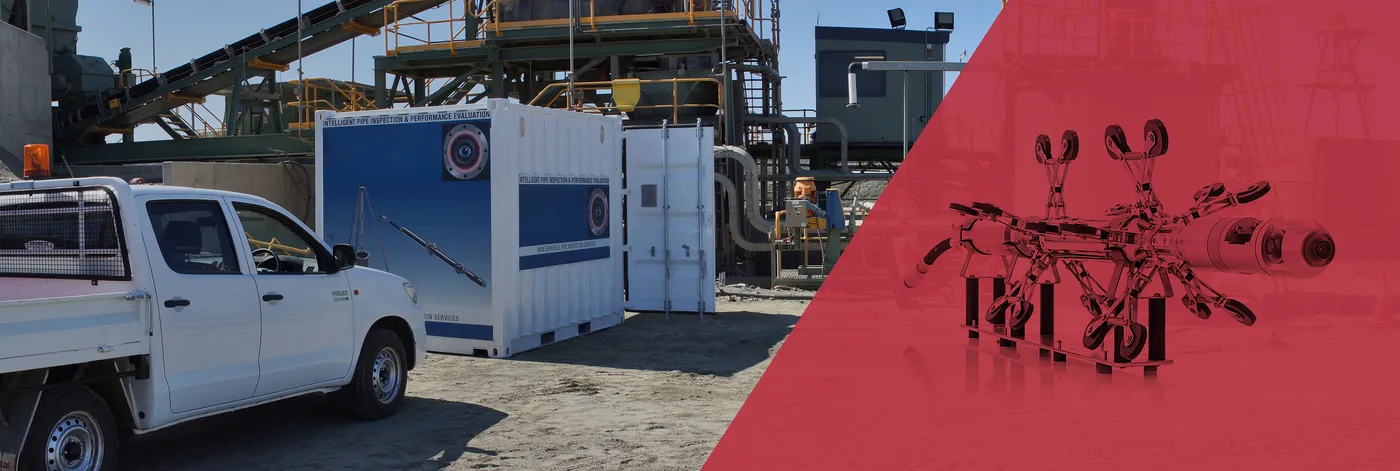
- Measuring robot as an elongated cylinder: electronics unit with rotary drive, angle sensor and slip ring, two centring units for different diameters, measuring head with laser distance sensors and cameras
- Cable drum with 500 m of cable and a 4-quadrant drive with frequency converter, emergency brake and distance measurement
- Workstation for the operators with control unit, console, video monitor and computer
Drum and workstation are built into transport containers. A partner company in Sydney developed the mechanics; we developed all electronics and software.
Implementation
- Proof of concept of the laser measuring system on sample pipes from the customer, selection of the sensors
- Development of the robot with our partner company and of its electronics
- Software for static and dynamic measurement, recording of videos and photos, and logging of the data
- Conversion of a cable drum to a 4-quadrant drive, with control, distance measurement and data transmission to the PC
- Assembly of the complete system in the transport container in Sydney, initial function tests
- Tests in pipelines of 4 and 8 inches at the customer's premises in Cardiff, optimisation of the centring units
- Practical tests at mines in Kambalda/Kalgoorlie (Western Australia, pipeline approx. 380 m long) and Mt. Isa (Queensland)
Further development
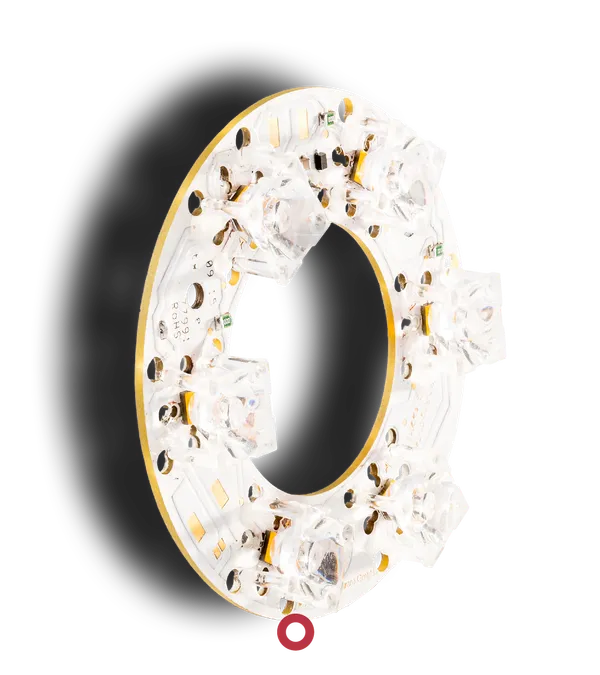
- Better video quality through high-resolution SD and HDTV cameras and improved lighting rings
- Extension of the working range to a cable length of 1,500 m (necessary in certain mines)
- Electric drive for the centring units so the robot cannot jam
- Software for wear trend analysis: more accurate remaining service life, better maintenance planning, minimal downtime costs